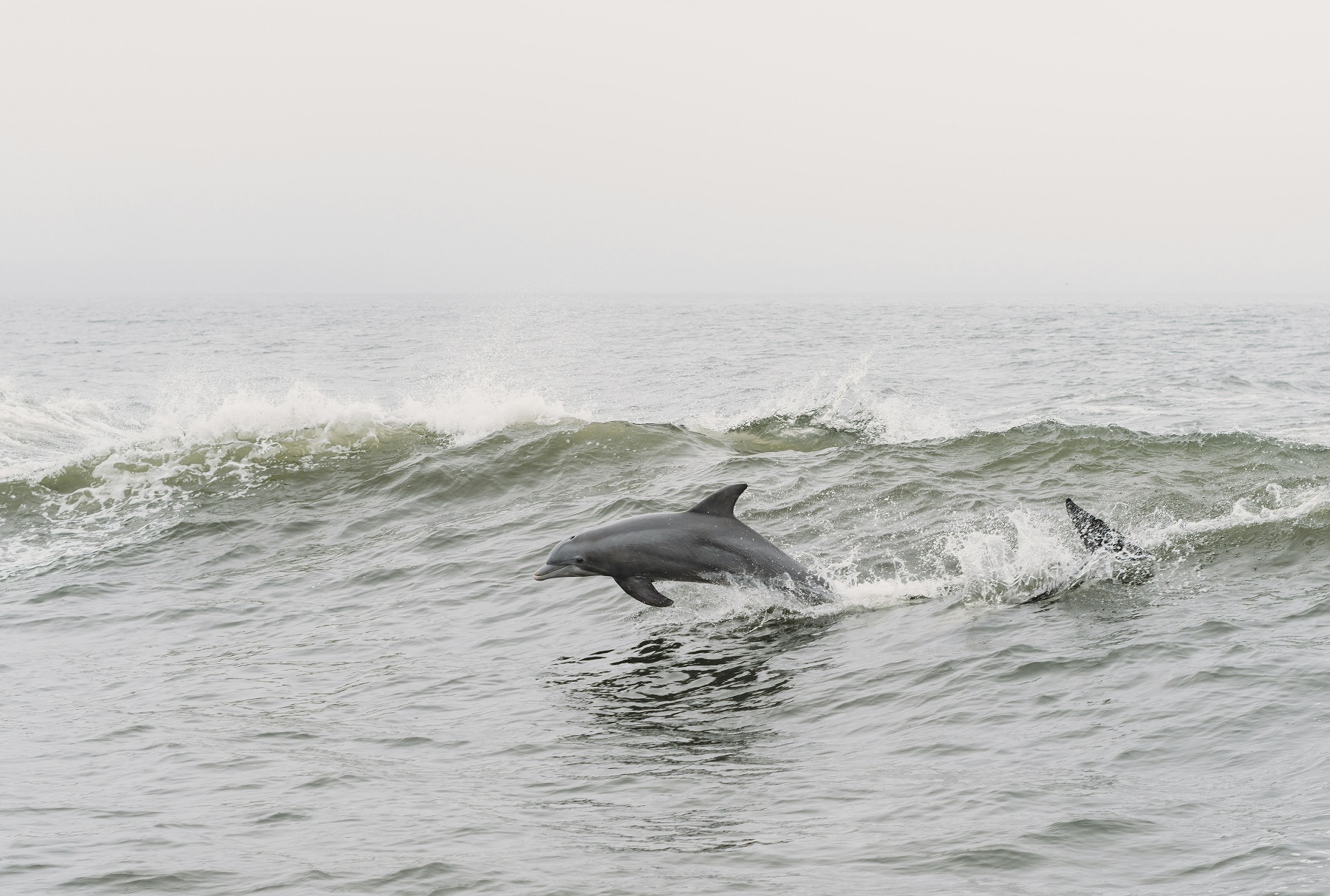
Signature whistles help estimate bottlenose dolphin abundance
Using signature whistles is an effective means for estimating abundance of bottlenose dolphins, new research confirms.
10 January 2025
Experts at Â鶹´«Ã½ analysed signature whistles produced by bottlenose dolphins (Tursiops truncatus) recorded off the Northumberland coast in north-east England and compared it to using photo-ID data of the species (a more labour-intensive method that requires photographically identifying dolphins during boat surveys). A total of 26 surveys were conducted and 5,771 hours of acoustic data were recorded across three sites from anchored recorders. The team found that the distinctive signature whistles offer a reliable method for estimating the abundance for the species that matches the accuracy of photo ID data.
, the study also provides the first abundance (number of individuals in a defined area) estimates for the species of approximately 60 individuals off Northumberland, United Kingdom. The results suggest that the Northumberland coast serves as an important habitat for a substantial portion of the East Coast bottlenose dolphin population, with approximately 30% of the total population frequenting the area during summer months.

Benefits of using signature whistles
Dr Matt Sharpe, PhD graduate at Â鶹´«Ã½, said: “Using signature whistles to estimate abundance offers several benefits. The main advantage is that collecting data is less resource intensive than conventional methods, such as transect sampling and capture-recapture based on photo-ID, which typically use data collected during boat-based surveys.â€�
Senior author, Per Berggren, Professor of Marine Megafauna Conservation, School of Natural and Environmental Sciences, Â鶹´«Ã½, said:
“This study not only reinforces the feasibility of using signature whistles for abundance estimation but also provides a foundation for future research using low-cost acoustic methods that can be applied regardless of location, weather and light conditions. Long-term monitoring using signature whistle analysis, could inform conservation strategies and improve understanding of the population’s spatial and temporal dynamics.�
Reference: Sharpe, M., & Berggren, P. (2024). A comparison of photo-ID and signature whistle based capture-recapture abundance estimates of common bottlenose dolphin. Marine Mammal Science, e13218.