Advanced Artificial Intelligence with Autonomous Systems MSc
- Study mode and duration
- Course code
- 5557F
- Fees (per year)
- Typical entry requirements
-
View full entry requirements - Course delivery
- On Campus
Course information for entry year:
Overview
Autonomous technology enables us to push the boundaries of research, innovation and exploration, from the deepest oceans to the human body.
In the age of advanced AI, how do we use this technology to develop safer and more intelligent innovations?
This course combines advanced AI training and the study of autonomous systems.
With the help of AI experts, you’ll discover which tools and techniques are best suited to certain challenges, and build on your knowledge of themes such as machine learning, deep learning and data science.
You'll then investigate how these technologies are being used in autonomous systems, including:
- how these systems build a picture of the world
- the sensors and cameras that make up a device, and how everything works together
- the decisions and ethics involved in creating autonomous systems
- the possibilities and pitfalls of introducing advanced and emerging AI technologies
Our career-focused curriculum also features industry-based projects which test your creativity, problem-solving and analytical abilities.
You’ll be taught by accomplished professionals, including specialists at the . Â鶹´«Ã½ is home to the , which is using the latest AI advances to solve global challenges. You'll also work with world-class experts at Future Mobility, who are investigating the future of sustainable, autonomous travel.
Learn what it takes to make a difference in this challenging yet fascinating field.
Who this course is for
This is a technical course for students with academic or work-related experience in a mathematics, computing or engineering subject.
Important information
We've highlighted important information about your course. Please take note of any deadlines.
Please rest assured we make all reasonable efforts to provide you with the programmes, services and facilities described. However, it may be necessary to make changes due to significant disruption, for example in response to Covid-19.
View our Academic experience page, which gives information about your Â鶹´«Ã½ study experience for the academic year 2025-26.
See our terms and conditions and student complaints information, which gives details of circumstances that may lead to changes to programmes, modules or University services.
Quality and ranking
Professional accreditations are reviewed regularly by professional bodies to ensure they meet the latest industry practices and regulatory standards. This keeps your degree rigorous, relevant, and highly valued by employers, providing a clear pathway into your chosen career.
If you are studying an accredited degree and considering a career in Europe after graduation, it is important to stay informed about international standards. The best resource for current information is the .
This official resource provides essential details on:
- whether your profession is regulated in another country.
- the specific steps you need to take to practice abroad.
- which organisations you should contact to begin the process.
Our students


Chatwipa from Thailand
Data Science MSc
I was impressed by the support provided to international students, especially the Airport Meet and Greet service.


Varsha from India
Data Science and AI MSc
Â鶹´«Ã½ truly feels like a second home, with its accessibility, vibrant student life and the amazing friends I’ve made along the way.

Harsh from India
Computer Game Engineering MSc
I was surprised at the diversity of Â鶹´«Ã½ - there are lots of students from all over the world studying here, and it is easy to make friends.
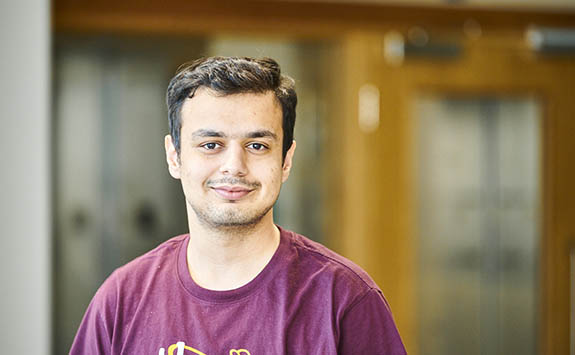
Shubh from India
MSc Cloud Computing
I chose Â鶹´«Ã½ because of its strong reputation in computing and the vibrant, research-led learning environment.

Hemanth from India
MSc Data Science & Artificial Intelligence
I’ve developed strong problem-solving and analytical skills, as well as practical experience with data analysis tools and programming languages.

Vaibhav from India
Computer Game Engineering MSc
My favourite thing about the MSc programme is the practical, hands-on approach to learning real game development skills.

Vivan from India
Data Science and AI MSc
This degree covers the full spectrum of modern data science and AI, from mathematical foundations to advanced topics.


Yiran from China
Data Science and AI MSc
The University also offers a lot of language assistance for international students, which helps make learning and everyday communication much easier.
What you'll learn
Phase one: Mastering Data Science and AI
You’ll begin by developing an advanced knowledge of data-driven systems and artificial intelligence. You’ll enhance your expertise in statistics and computer science, and explore themes such as machine learning, and deep learning with probabilistic modelling.
We will then introduce more advanced technical models, exploring aspects such as:
- professionalism
- legislation
- ethics
Phase two: AI in Autonomous Systems
You will then explore how autonomous systems work, and the various technologies that go into making them work effectively in the real world.
You will discuss facets of autonomous engineering such as world models and sensors, learn how to derive valuable insights from data, and discover how AI is integrated into autonomous models.
Phase three: Capstone project
This in-depth research project will allow you to showcase your understanding of both AI and autonomous systems.
It may consist of:
- a research dissertation on an AI and autonomous systems topic
- an individual project related to AI and autonomous systems. This could involve examining a real-world problem, or designing a prototype
Modules
The module information on our course pages is intended to provide an example of what you will study.
Our teaching is informed by research. Course content changes periodically to reflect developments in the discipline, the requirements of external bodies and partners, and student feedback.
Full details of the modules on offer will be published through the Programme Regulations and Specifications ahead of each academic year. This usually happens in May.
Some courses have optional modules. Student demand for optional modules may affect availability.
| Compulsory Modules | Credits |
|---|---|
| Data Science and AI in Practice | 20 |
| Frontier Topics in Artificial Intelligence | 20 |
| Machine Learning, Deep Learning with Probabilistic Modelling | 20 |
| 20 | |
| Foundations of Autonomous Systems | 20 |
| AI in Embodied Autonomous Systems | 20 |
You'll then choose one 60 credit module from the following:
| Optional Modules | Credits |
|---|---|
| Case Study Project (Advanced) | 60 |
| Individual Project (Advanced) | 60 |
| Individual Project | 60 |
Module information for 2027 entry
The modules listed here show our planned 2027 curriculum, but the links connect to our live 2026 modules (as the 2027 ones are not yet live). Consequently, some titles may differ, and certain new modules may not be viewable yet. Some modules are also listed as inactive, but will be active for 2027 entry. The updated 2027 module details will be published ahead of the academic year.
How you'll learn
You will be taught using a range of methods, including:
- lectures
- seminars
- practical sessions
- individual projects
- group projects
- guided independent study
- self-directed learning
Depending on your modules, you'll be assessed through a combination of:
- Oral presentation
- Problem-solving exercises
- Report
Some assessments will involve our specialist software, Numbas.
As part of the module delivered by NICD, you’ll collaborate with a group to complete an assignment and deliver an oral presentation, which will contribute to your assessment.
You’ll demonstrate your software coursework for the AI modules, giving you the chance to showcase your practical abilities and how you’ve applied your learning.
Practical sessions
The course is made up of a large number of practical sessions, allowing you to try out different skills and techniques with the support of academic staff and demonstrators.
Numbas learning software
You'll have access to specialist learning software called Numbas. Developed at Â鶹´«Ã½, it's now used by mathematicians and statisticians worldwide. This innovative software allows you to work on interactive code worksheets, so you can test and refine the mathematics skills you’ll need for data science.
Statistics and Data Science Clinic
During your capstone project, you’ll be supported by our Statistics and Data Science Clinic. You can book one-to-one sessions with our expert data scientists. Whether you need support with a technical issue or refining your analysis, tailored support is available to help your project progress. This support is in addition to your project supervisor.
The School of Computing has a dedicated Wellbeing Advisor who understands the needs of our students.
They can be a confidential listening ear and provide guidance on a range of wellbeing issues.
Throughout your studies, you’ll have access to support from:
- academic staff
- academic advisers and research supervisors
- our University Student Services Team
- student representatives
- peers
You'll also be assigned an academic member of staff, who will be your academic adviser throughout your time with us. They can help with academic and personal issues.
Your teaching and learning is also supported by Canvas. Canvas is a Virtual Learning Environment. You'll use Canvas to submit your assignments and access your:
- module handbooks
- course materials
- groups
- course announcements and notifications
- written feedback
The course is delivered by:
You’ll work alongside academics who are at the forefront of research and industry collaboration, including:
- Centre for Data Science and AI: Driving the development and application of new methods for extracting the value from data.
- Statistics and Data Science: World-class research in modern statistics and data science.
- Scalable Computing: Internationally renowned for tackling research challenges in high-performance systems, data science, machine learning and data visualisation.
- Future Mobility: A world-leading multidisciplinary centre for sustainable, automated, connected, resilient and inclusive mobility.
- National Edge AI Hub: Delivering world-class research on how innovative AI can address challenges in fields from healthcare to power-efficient electronics.
We are also home to the which collaborates with industry partners across multiple sectors.
We have established links with many leading national and global companies, who help to shape the curriculum and offer guest speakers as well as networking and mentoring opportunities.
Entry requirements
The entrance requirements below apply to 2027 entry.
Our entry requirements and offer information will be finalised in September 2026. Please check the website for any updates at the beginning of September.
Qualifications from outside the UK
English Language requirements
Admissions policy
This policy applies to all undergraduate and postgraduate admissions at Â鶹´«Ã½. It is intended to provide information about our admissions policies and procedures to applicants and potential applicants, to their advisors and family members, and to staff of the University.
University Admissions Policy and related policies and procedures
Credit transfer and Recognition of Prior Learning
Recognition of Prior Learning (RPL) can allow you to convert existing relevant university-level knowledge, skills and experience into credits towards a qualification. Find out more about the RPL policy which may apply to this course
Your development
You’ll build practical expertise in statistical methods, machine learning and deep learning, and develop hands-on skills in visualisation and the analysis of complex data.
You’ll also strengthen your teamwork and communication skills by working on a group project. You’ll learn how to present your findings clearly to non-specialist audiences.
Research skills
You’ll learn how to formulate and deliver in-depth and data-driven research projects. Key skills will include formulating robust hypotheses, selecting appropriate analytical methods, analysing data and communicating findings in a clear and compelling way.
You will also build confidence in AI-focused technical evaluation.
Practical skills
You’ll graduate with the ability to apply your skills to real-world challenges.
These include:
- applying computing, mathematical and statistical techniques to data storage and analysis
- using modern programming languages, libraries and AI frameworks
- how to use and control industry-standard robotics and AI software
- how to design the right systems and tools for a particular problem
- how to interpret data from autonomous systems
- building, training and evaluating predictive models across a range of data domains
Work experience opportunities
While this course does not include a formal placement, you will gain practical experience through working with our industry partners on real-world projects.
Your future
The potential of autonomous systems is being explored in a range of exciting industries, from driverless cars to marine and space exploration.
You will graduate with a skillset that combines advanced artificial intelligence, data science and specialised knowledge of autonomous systems.
Potential roles for graduates include:
- AI engineer
- data scientist
- AI solutions architect
- machine learning engineer
- autonomous systems engineer
- robotics engineer
- technology and data consultant
Further study
Once you graduate this course, you’ll have the grounding required to progress to PhD level study and further research opportunities in academia.
Industry links
We are supported by an Industrial Advisory Board (IAB) that provides strategic advice and industry insights to support the development of programmes in the School of Computing. The IAB includes representatives from:
- Meta
- IBM
- The Alan Turing Institute
- Airbus
- Defence Science and Technology Laboratory (DSTL)
- JP Morgan
- Lloyds Bank
- PwC
These connections provide you with numerous benefits, potential employment upon graduation and industry-sponsored projects.
AI careers support
Our dedicated careers support team offers specialised guidance tailored to AI students. This includes:
- career planning
- workshops on resume-building and interview techniques
- networking events with industry leaders
- job fairs focused on AI analytics
- access to an extensive alumni network for mentorship and job referrals
- support for start-ups
Our Careers Service
Our expert Careers Service is here to help you take the next steps in your professional life. We will support you while you’re studying with us and for up to three years after you graduate.
You will have access to expert one-to-one advice and guidance through our campus careers centre and online, along with digital resources, workshops, networking opportunities, and careers and recruitment events.
We’ve been awarded 5 QS Stars for Student Employability (2025). Many of our degrees are shaped by strong links with national and international businesses. We are committed to helping you access real-world experience opportunities and develop key skills through paid work placements and internships.
Facilities
Urban Sciences Building
The School of Computing is based in the £58 million Urban Sciences Building (USB), a flagship development located on the £350 million Â鶹´«Ã½ Helix regeneration site in the heart of Â鶹´«Ã½. Â鶹´«Ã½ Helix brings together:
- academia
- the public sector
- communities
- business and industry
The USB is a living laboratory and has over 4,000 sensors that record detailed research data, which can be used in student projects.
Helix is home to both the and the , making it a vibrant space for AI and data science exploration and partnerships.
As a student, you'll have access to facilities including:
- 300+ PCs
- large, flexible computer clusters
- collaborative spaces for study or group projects
- dedicated practical space for postgraduate students
- Urban Café
As postgraduate students, you will have access to specialist teaching spaces and facilities in the USB.
Wellbeing and inclusivity are at the heart of our School. The USB has several wellbeing spaces for students, including a prayer room for all faiths and none. This space can be used for prayer or quiet reflection.
Explore the Urban Sciences Building
Learn more about the Â鶹´«Ã½ Helix
Find out more about our wellbeing and computing facilities
Stephenson Building
The Stephenson Building is a £110 million investment in world-class education, research and collaboration across Engineering.
It’s a place for future engineers, researchers and designers to collaborate and tackle global challenges, together.
You'll have access to state-of-the-art equipment and facilities including:
- Robotics Laboratory
- The Makerspace
- Fabrication Facilities
- Electronics Laboratories
Urban Sciences Building
The School of Computing is based in the £58 million Urban Sciences Building (USB), a flagship development located on the £350 million Â鶹´«Ã½ Helix regeneration site in the heart of Â鶹´«Ã½. It brings together:
- academia
- the public sector
- communities
- business and industry
Postgraduate student facilities
As a Master's student, you'll have access to specialist teaching spaces and facilities in the USB. These are only available to postgraduate students.
Wellbeing and inclusivity are at the heart of our School. The USB has several wellbeing spaces for students, including a prayer room for all faiths and none. This space can be used for prayer or quiet reflection.
Fees, Funding and Scholarships
Tuition fees for 2027 entry (per year)
As a general principle, you should expect the tuition fee to increase in each subsequent academic year of your course, subject to government regulations on fee increases and in line with inflation.
Depending on your residency history, if you’re a student from the EU, other EEA or a Swiss national, with settled or pre-settled status under the EU Settlement Scheme, you’ll normally pay the ‘Home’ tuition fee rate and may be eligible for Student Finance England support.
EU students without settled or pre-settled status will normally be charged fees at the ‘International’ rate and will not be eligible for Student Finance England support. You may be eligible for a scholarship worth 25% off the international fee. Search our funding database.
Scholarships
We support our EU and international students by providing a generous range of Vice-Chancellor's automatic and merit-based scholarships. See our searchable postgraduate funding page for more information.
Search for funding and scholarships
Find funding available for your course
What you're paying for
Tuition fees include the costs of:
- matriculation
- registration
- tuition (or supervision)
- library access
- examination
- re-examination
- graduation
Find out more about:
If you are an international student or a student from the EU, EEA or Switzerland and you need a visa to study in the UK, you may have to pay a deposit.
You can check this in the How to apply section.
If you're applying for funding, always check the funding application deadline. This deadline may be earlier than the application deadline for your course.
For some funding schemes, you need to have received an offer of a place on a course before you can apply for the funding.
How to apply
Using the application portal
The application portal has instructions to guide you through your application. It will tell you what documents you need and how to upload them.
You can choose to start your application, save your details and come back to complete it later.
If you’re ready, you can select Apply Online and you’ll be taken directly to the application portal.
Alternatively you can find out more about applying on our applications and offers pages.
Open days and events
Find out about how you can visit Â鶹´«Ã½ in person and virtually
Overseas events
We regularly travel overseas to meet with students interested in studying at Â鶹´«Ã½.
Get in touch
Questions about this course?
If you have specific questions about this course you can contact:
Postgraduate Computing
Email: computing.admissions@newcastle.ac.uk
School of Computing
Enquiries
If you've got a question about your application, send us an enquiry via the application portal you applied through.
If you haven't applied yet, or have a general enquiry, you can send your questions via our enquiry form.
Chat to our students
Choosing a university is a big decision. If you've got questions about a particular course, student life or the city of Â鶹´«Ã½, why not chat to our friendly students or graduates!
Keep updated
We regularly send email updates and extra information about the University.
Receive regular updates by email
Social Media
Get involved with the School of Computing.