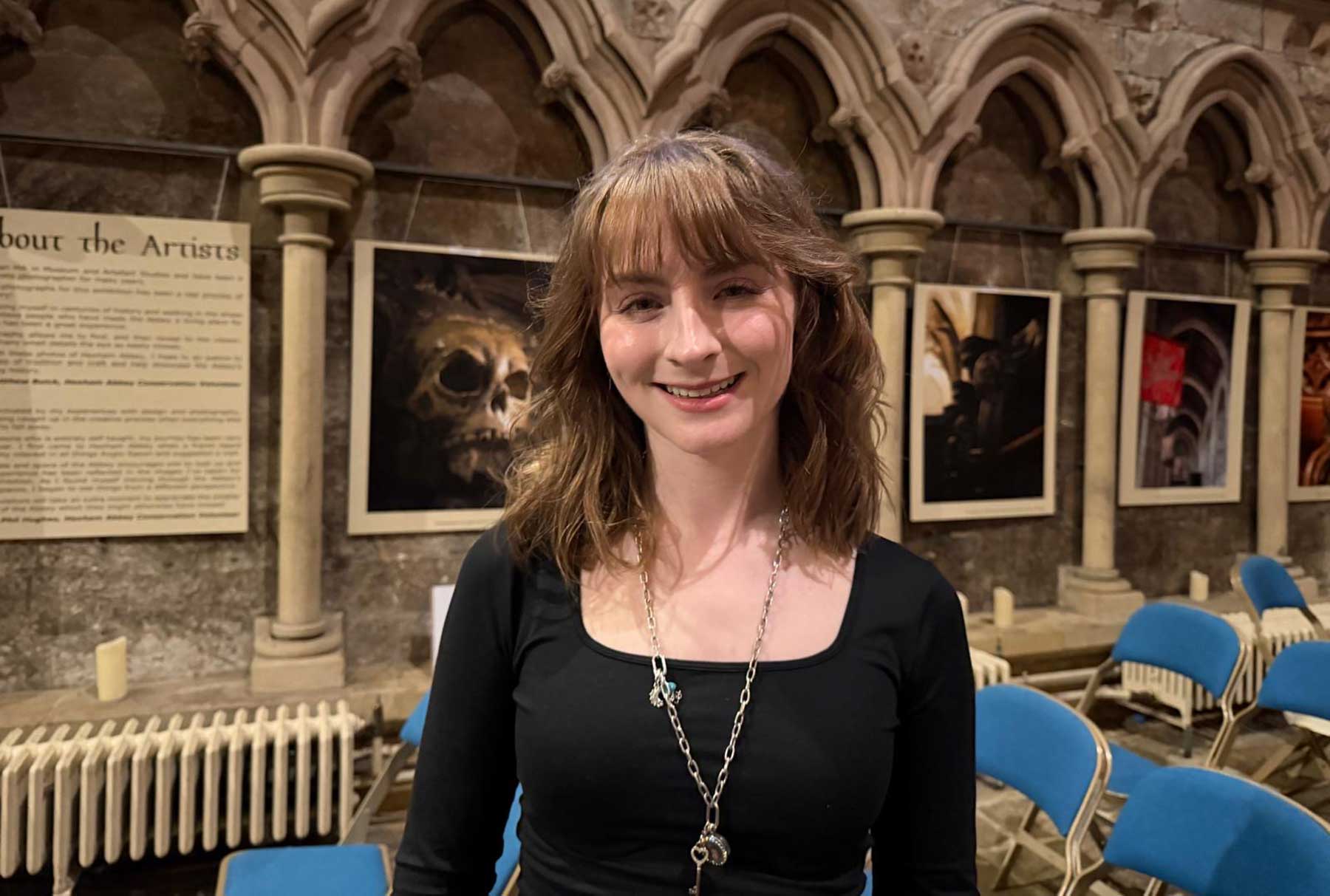
Meet Alexandra
Fine Art MA Music BA
Why did you choose Â鶹´«Ã½?
Â鶹´«Ã½ offered the opportunity to pursue both of my passions, music and art, at a university with an excellent academic reputation.
The Music department particularly appealed to me and I was impressed by the range of performance opportunities and excellent vocal tuition available alongside the rigorous academic side of the course.
When it came to choosing a Master’s degree, the decision felt very natural. I had thoroughly enjoyed my undergraduate experience, made wonderful friends, become heavily involved in societies and felt completely at home in Â鶹´«Ã½.
The excellent reputation of the Fine Art programme, combined with my positive experience as an undergraduate, made staying at Â鶹´«Ã½ an easy choice.

What do you love about Â鶹´«Ã½?
What I love most about Â鶹´«Ã½ is the sense of community and the incredible range of opportunities available.
I’ve always enjoyed keeping busy and Â鶹´«Ã½ has let me fully immerse myself in everything I love, from music and theatre to art and exhibitions.
Being involved with Â鶹´«Ã½ Gilbert & Sullivan Society (NUGSS) and the various choirs has created some of my favourite memories.
Performing in shows and concerts, working with talented and enthusiastic people and seeing productions come together has been hugely rewarding.
I’ve also really enjoyed the opportunities within my courses to perform, exhibit work and develop my creative practice.
The city itself is incredibly welcoming and friendly. I’ve made lifelong friends here, and Â鶹´«Ã½ has become a place where I feel supported, challenged and encouraged to make the most of every opportunity.
One of the things I value most about Â鶹´«Ã½ is that it has given me the confidence and opportunities to follow more than one creative path.
I came to study Music, but throughout my undergraduate degree I was also able to continue exploring my interest in visual art through societies, exhibitions and creative projects.
After graduating with a First-Class honours degree in Music, I chose to remain at Â鶹´«Ã½ to pursue a master’s in Fine Art.
Being able to explore and develop both disciplines within a supportive and inspiring environment has been one of the most rewarding aspects of my university experience.
What surprised you about Â鶹´«Ã½?
What surprised me most about Â鶹´«Ã½ was just how much there was to get involved in. I expected to enjoy my course, but I didn’t realise how many opportunities there would be outside of my studies. Whether it was music, theatre, art, societies or leadership roles, there always seemed to be something exciting happening.
I was also surprised by how quickly Â鶹´«Ã½ felt like home. The friendliness of both the University and the city made settling in incredibly easy. Before long I had built a busy and fulfilling life here. Looking back, I don’t think I realised just how much Â鶹´«Ã½ would shape me academically, creatively and personally.
What student support services have you accessed and how have they helped you?
I have a specific learning disability and dyspraxia. I worked with the University’s disability support team to put a Student Support Plan in place. The support I received made a huge difference to my studies and ensured I could access my course in the way that worked best for me.
Having a Student Support Plan also allowed me to request extensions when needed. Without that support, I'd have found it much more difficult to complete assignments to the best of my ability. The adjustments helped me manage my workload effectively and ultimately contributed to me achieving a First-Class degree in my undergraduate studies, which I'm incredibly proud of.
I've also used the Careers Service to discuss future plans and explore different opportunities. Those conversations helped me reflect on my interests and ultimately gave me the confidence to pursue a Master’s degree in Fine Art after completing my undergraduate degree in Music.
The city itself is incredibly welcoming and friendly. I’ve made lifelong friends here, and Â鶹´«Ã½ has become a place where I feel supported, challenged and encouraged to make the most of every opportunity.
Did you get involved in any extracurricular opportunities?
One of the things I love most about Â鶹´«Ã½ is how easy it is to get involved in activities outside of your degree and I’ve tried to make the most of every opportunity available.
A large part of my week revolves around music and performance. I sing with Â鶹´«Ã½ Bach Choir, where I am currently a scholar, Â鶹´«Ã½ Cathedral Consort, Schola Cantorum (keeping in touch with my chorister roots), and Bishopwearmouth Choral Society, for which I also held a scholarship.
Alongside this, I have been heavily involved with NUGSS as both a cast member and committee member.
I’ve also joined a variety of other societies, including Surf Society, Music, Art, Photography and Film societies. There were so many opportunities available that I couldn’t fit everything in! These experiences have helped me develop confidence, leadership skills and friendships while allowing me to pursue the things I am passionate about.
How have you found the social aspect of University?
The social aspect of university has been fantastic. Through choirs, productions and societies, I’ve met people from a wide range of backgrounds who share many of my interests and passions.
A lot of my free time revolves around music, theatre and art. Through NUGSS I’ve not only performed in productions, but have had opportunities to get involved with set design and costumes, which has been a really enjoyable creative outlet. Singing in choirs and performing in concerts has also been a huge part of my university experience.
Outside of university activities, I enjoy spending time with friends, whether that’s going to the beach, out for food, cocktails or a trip to the pub. I also love hosting themed parties, which has become something of a tradition among my friendship group!
The course encourages me to pursue ideas and themes that genuinely interest me, while challenging me to develop them further through discussion, experimentation and critical reflection.
Have you joined a society or club?
Absolutely! I joined NUGSS during Freshers’ Week and have loved every minute of it. I’m now a committee member, and being involved both on stage and behind the scenes has been one of the highlights of my time at Â鶹´«Ã½.
Alongside NUGSS, I’ve also been involved with Music Society, Art, Film and Photography Societies, as well as several choirs and musical groups throughout my studies.
What I enjoy most about societies is the people. They’ve given me the opportunity to make lasting friendships with like-minded people and share experiences with others who are passionate about the same things. Whether it’s rehearsals, performances, concerts, society balls, socials or pub trips, many of my happiest university memories have come through being part of Â鶹´«Ã½’s societies.
The alumni discount and School of Arts and Culture scholarship made a significant difference to my postgraduate studies. The financial support...allowed me to dedicate more time and energy to my academic work
Describe your degree to a future student?
MA Fine Art is a studio-based course that has given me the freedom to develop my own artistic practice, while encouraging me to experiment with new ideas, materials, media and ways of working.
It's a supportive but challenging environment where experimentation, critical thinking and research are all valued.
As an artist working primarily in portraiture through photography, drawing and painting, the course has helped me expand and evolve my practice into something more cohesive and interdisciplinary.
The programme also combines practical artistic development with professional experience in exhibiting, curating and different ways of writing about art, helping students prepare for life beyond university.
What stands out for you about your degree?
The balance between independence and the breadth of opportunities available beyond the studio.
The course encourages you to take ownership of your practice while providing access to supportive and experienced tutors, critical discussion and a vibrant artistic community.
The course has enabled me to pursue workshops that have expanded my artistic experience and introduced me to new approaches to making work.
One particularly memorable opportunity was taking a workshop series in anatomy at the Medical School, which offered a completely different perspective on life drawing and the human form, connecting biological science directly to artistic expression.
Â鶹´«Ã½ has helped me understand my future more clearly by giving me the space to connect my practical experience as a music teacher with deeper academic and professional thinking.
What do you enjoy the most about your degree?
The balance between creative freedom and constructive support. The course encourages me to pursue ideas and themes that genuinely interest me, while challenging me to develop them further through discussion, experimentation and critical reflection.
As mentioned earlier, the anatomy workshops have been a particular highlight. They were both fascinating and empowering, helping to strengthen my technical abilities, observational skills and confidence as an artist. They also offered a unique perspective on the human form that has informed my current work.
My practice explores portraiture, anatomy, gothic literature, memento mori and atmosphere. I do this through photography, painting and drawing, while increasingly incorporating videography, sound, lighting, set design and immersive installation. The course has provided the opportunity and encouragement to bring these different disciplines together, allowing my work to become more ambitious, cohesive and interdisciplinary.
I have also valued the opportunities to exhibit work, collaborate with others and gain experience in curating and art writing. Equally important are the class discussions and critiques, which take place in a relaxed and supportive environment. These conversations have challenged me to think more deeply about my work while learning from the diverse perspectives and practices of my peers.
Overall, the degree has helped refine my artistic voice, expand my skill set, and develop a clearer sense of direction for my future practice.
Did you receive any funding, if so, how did it help?
The alumni discount and School of Arts and Culture scholarship made a significant difference to my postgraduate studies.
The financial support reduced the pressure of supporting myself while studying. This allowed me to dedicate more time and energy to my academic work.
As someone with a specific learning disability, I often require additional time to complete reading, research and assessments.
The funding enabled me to focus on producing work to the best of my ability rather than balancing excessive paid employment alongside my studies. This contributed positively to both my academic performance and overall university experience.
What was the course application process like and what are your top tips for applying?
Once I had refined my portfolio and personal statement, the application process for the Fine Art Master’s was very straightforward.
The interview was a valuable opportunity to discuss my practice, future ideas and the directions I wanted to explore through the course.
My tip for applying to Â鶹´«Ã½ would be to prepare thoroughly: spend time curating a strong portfolio that reflects your current interests. Think carefully about your artistic ambitions, and research the course so you can explain why it is the right fit for you.
It's also helpful to be ready to discuss your strengths and the areas of your practice that you would like to develop.
Most importantly, be enthusiastic and authentic. Showing a genuine passion for your work and a willingness to grow as an artist will make a good impression.
Where do you see yourself in the future?
While it can be difficult in the current employment climate to know exactly where the future will lead, I have always been driven by a desire to work within the creative industries.
I'm particularly drawn to roles in television and film, especially in production, costume, set, or prop design. Here I can bring together creativity, research, and hands-on making.
I'm equally interested in opportunities within theatre, opera and museum sectors. These fields also offer rich possibilities for storytelling, collaboration and creating immersive experiences for audiences.
Ultimately, my goal is to build a career that allows me to contribute to meaningful creative projects while continuing to grow and develop my own artistic practice along the way.
How has Â鶹´«Ã½ helped you realise your future?
Â鶹´«Ã½ has played a huge role in helping me realise my future ambitions. It's allowed me to pursue my passions for both art and music, while developing the skills and experience needed for a career in the creative industries.
Through my Fine Art studies, I've been able to explore exhibition-making, curation, research and professional practice, giving me a strong foundation in both creative and cultural work.
As part of my undergraduate Music degree, I had the opportunity to perform in and work as Assistant Director on a Baroque opera production. This gave me invaluable experience of theatre production, collaboration and creative leadership.
Alongside this, my role as Artistic and Creative Director for NUGSS has allowed me to take on responsibility for creative projects and further develop my skills in production and project management.
The financial support I received through the alumni discount and School of Arts and Culture scholarship was equally important, as it enabled me to dedicate more time to my studies and make the most of these opportunities.
Looking back, Â鶹´«Ã½ has given me far more than a first-class education, it has provided the experiences, confidence, professional portfolio and sense of direction that will help me pursue a future in the creative and cultural sectors.
Why should a student pick this degree?
I would recommend this degree to any student who is passionate about developing their creative practice in a supportive and inspiring environment.
One of the greatest strengths of the course is the freedom it gives you to explore and refine your own interests while being challenged and supported by knowledgeable staff and a community of fellow artists.
I particularly value the combination of practical making, critical discussion, research and professional development, which is helping me grow in confidence and expand my skills.
The opportunities to exhibit work, engage with contemporary art practices and develop a professional portfolio make the degree an invaluable stepping stone towards a career in the creative and cultural industries.
It's also worth recognising Â鶹´«Ã½’s pioneering role in the arts, as the first UK university to award a Fine Art degree.
That legacy of innovation, combined with its continued reputation for excellence, is a clear reason why Â鶹´«Ã½ remains such a highly regarded institution today.
Related student stories


Lawrence from United Kingdom
Mathematics MMath
There’s a great balance between mathematical theory and computational work.

John from India
Geospatial Surveying and Mapping BEng
My course focuses on land and marine surveying applications. What sets the University apart in this area are the dedicated labs.
Aaryan from India
Computer Science BSc
To support my studies, I’ve been awarded a VCIS (Vice Chancellor International Scholarship) worth £4,000. The rest of my fees are self-funded.

Lukman from Nigeria
Mechanical and Systems Engineering PhD
Â鶹´«Ã½ really welcomes international students. It’s clear that the institution strongly values inclusion and diversity.
Madiha from India
English Literature with Creative Writing BA
The application process was straightforward and I felt very supported by the University throughout.

Jasmine from Malaysia
Dietetics MDiet
Â鶹´«Ã½ feels like somewhere between a big city and a small town.

Hana from Czechia
International Business Management BSc
I’m not sure what I want to do in the future, being able to study lots of different modules is giving me the chance to explore all the possibilities.

Bernardo from Brazil
Law PhD
I am deeply passionate about the RED (Researcher Education and Development) programme - it has been an integral part of my PhD journey.

Aytach from Azerbaijan
Media and Public Relations MA
There is so much I enjoy about my course: the modules, practical tasks and assignments.